finding the way

Thursday, September 28, 2006

Reflexions

So far, I feel happy with the general concept but I know that I really need to think about the content of the videos. Do I want to tell stories, do I just want to see people doing their daily and maybe boring activities, do I want to reveal secret of the city?

Today I realized that I also have the problem of the “installation”. I definitely want to bring the private to the public space so I want to install the piece in a public space and I think this is clear. But then I had the idea of doing something interactive (the interactive door project that I proposed in which you choose a location to see the video of this specific location).

But when talking today with Adam (My thesis teacher) he told me that he doesn’t see my piece as something necessarily interactive. He thinks that is more an installation in a public space with a lot of small doors (also told me about the idea of doing a kind ok sculpture as the interface full of different kind of doors) and a bunch of videos behind which you can watch. I know that when thinking of interactivity it is very important to have a compelling reason for that other wise it doesn’t make any sense but my feeling is that if I do not have interactive component I feel that I am missing something…

The other point is that, do not ask me how, I am going to end up doing an art piece instead of a design project (which I find interesting and maybe healthy for my brain, but I little bit scary. ) I feel I am absolutely more a designer than an artist and I am kind of scary to enter into a realm that is kind of unknown for me

This is the end of my psychoanalysis session today.
More References

I presented my project last week and it seems that I am in the right track. I am going to desing an a project that allows people to explore the private life of the city. ( Using peepholes / wall cracks as interfacaces and video as content). My concern now is HOW to formalize the project but more than that is WHAT is going to be the content of the videos. I need to start experimenting and recording some videos in order to figure out what stories do I want to tell.

I started doing some small experiments videotaping friends and trying to see what is more interesting. I found out that video without sound is much more complelling that having both because it generates a lot of curiosity. Having a still image and sound it is also another choice.

I have been looking at different projects / artist / and experiments that deals with the idea of “spying and looking at people's private daily events”.

Shaun told me about feeds for networked security cameras. I was looking at a parking lot and it was really nice when I could see some cars moving. It made me think how exiting it would be if I can so something in real time, but I guess this would be another story.

Chris Sugrue who graduated from Parsons did a set of experiments for her thesis related to vision tracking. Re-Gaze explores relationships between vision and imagery. It emerges from an investigation into the human visual system, eye tracking, visual illusion, and studies in psychology and cognitive science. Within the installation, the visual fixations and eye movements of an individual cause a sequence of images to react, form and respond to being seen. This interactive process of viewing engages the audience with a dialog about the public and private, voluntary and involuntary manifestations of looking and seeing. Vision tracking: Used computer vision techniques to develop create C++ system to track human eye movements.

Bill Viola and his Sleepers, a video installation in which seven black-and-white monitors showing unedited recordings of various sleeping faces are positioned in metal barrels filled to the brim wit water, the soft light from the video screens diffusing in the room, the viewer is confronted with an almost Kafkaesque nightmare of unconscious alienation. Interesting quote about images vs sound that is one of my concerns while doing videotaping people: “ the spectator has to pass through the silent, but optically very ‹loud› electronic flow of data, in order to reach a dark space”.

Dieter Roth: «Solo Scenes».
A video-installation (here in the gallery Hauser & Wirths, Zurich) with 128 videotapes presented alternately on at least 40 monitors. The tapes demonstrate Dieter Roth´s everyday life and were recorded from 3rd March 1997 to 28th April 1998 in Bali, Iceland and various places in Basel. The following animated stills render the idea of the work.

Tenement Museum

Interesting and lovely on lines tours to see emigrants’ houses.
I will go to check how are the real tours (The Confino Family Apartment: This "living history" apartment is based on the Sephardic-Jewish Confino family from Kastoria.

Ellen Harvey
The paintings were the work of well-known artist Ellen Harvey. Documented here are both the works and Harvey's diary-like experiences of painting illegally throughout the city. The narrative of her “beautification project” is both provocative and hilarious. It touches on serious issues, such as who is allowed to make art in our society and what distinguishes art from graffiti, while never losing touch with the frequently comical reality of creating a contemporary art project on the streets of New York.

Peepholes
Project made at ITP that use a peephole as an interface to allow a person to look through a keyhole in a door in one space and view inside an old living room in another space. In the old living room, there is an old console television; the eye of the person that is peeping into the room is displayed on the old TV. They were inspired by the constraints of privacy in our world today and by the idea of how we see the world and how the world sees us.

Jonas Dahlberg

Finding one's bearings - on Jonas Dahlberg's intermediary spaces
Discovered that from his windows he had an unimpeded view into his neighbour's house on the other side of the street. The wall in there was decorated with an arsenal of weaponry. This threatening image in his existence prompted the artist to furnish his own apartment only as far as the zones that the other man in turn could not see. See other works.

Marcel Duchamp
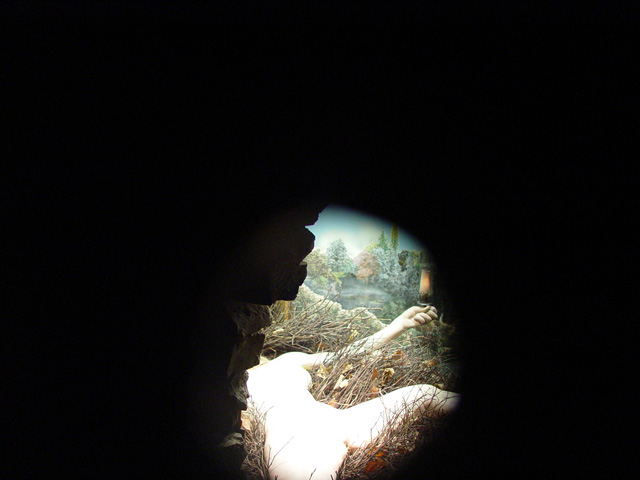
Given:1. The Waterfall, 2. The Illuminating Gas.

Saturday, September 16, 2006

Conflux

Looking at Conflux I found some very interesting projects !!!
Planning to go tomorrow to "experience" some of them.

Free Money Release by Sal Randolph.
Search the streets and sidewalks of Williamsburg for lucky envelopes containing money.

Have a Seat
Caroline Woolard. Public seating in an unused space: the stop sign post.

Artistic Souvenirs from Brooklyn
Suvi Aarnio
A collaborative project with the aim of studying the unknown, public realm through personal, site-specific experiences and transforming them into artistic souvenirs.

The Former Resident Project
Rachelle Viader Knowles
Stories of Brooklyn from former residents, on-line and as one off fridge magnets on the streets... follow the map, find a story... take it home.

Tell Tales - a City Guide
Rupert Hartley
Tell Tales – a city guide is a collection of extracts from literary novels descriptive of places. The extracts have been grouped into scenes, gazes, walks and detours to select, create and document city walks.

Brooklyn Mud Map
Hugh Davies, Analogue Art Map
To navigate Brooklyn for two days using only maps drawn by Brooklynites upon request for directions.

Huston's Museum for Missing Places

Eric Leshinsky
Lecture

Lynch Debord! About Two Psychogeographies
Denis Wood
Lecture

Killing the Fathers, or: If You Meet Jane Jacobs On The Road...
Adam Greenfield
Lecture: Reimagining urbanist thought for the age of ambient informatics.

Experimental Tourism

Looking at Conflux projects I found that there is actually an Experimental Tourism researcher called Joel Henry who directs Laboratory of Experimental Tourism at France (Latourex).

Wikipedia defines ET a novel approach to tourism in which visitors don’t visit the ordinary tourist attractions (or, at least not with the ordinary approach), but allow whim to guide them. There are a number of approaches, some of them more interesting that others but all are related to the idea choosing destinations not on their standard touristic merit but on the basis of an idea or experiment. It often involves elements of humor, serendipity, and chance. Although I am not thinking on creating exactly "a tour like those" and I am not sure if I would be willing to take them, some examples related to the idea of learning from locals and following people which I is related to what I am looking for in some way:

Barman's knock - visit a bar, ask the bartender where their favorite bar is and what they drink there. Visit that bar, do the same with the bartender there, and continue.
Random micro-travel - meet up with friends in a cafe on a Saturday morning. Put your house keys, name and address in an envelope. Mix up all the envelopes and redistribute them randomly
Spend the weekend at the address in the envelope you are given, keeping all the appointments (lunch, brunch or dinner) made by the usual occupant.
Travel-Pursuit - follow some friends when they go on holiday and don't let them out of your sight. Take lots of photos of them using a tele-photo lens. On their return home, welcome them with a slideshow of their holiday.

Also the Lonely Planet published The Lonely Planet Guide to Experimental Travel , which formalised and developed many of Henry's ideas. And an article in CNN about the subject.

Rent a Tourist
Hypothesis: Explore the working life of the city and learn about the locals by renting yourself out to help with daily chores.
Apparatus: Paints or pens to make a sign, a sales pitch and a device to draw attention to yourself (eg loudspeaker, red flashing light).
Method : Stand in the main square or plaza with a sign advertising yourself as a tourist 'for rent'. If you have time, consider handing out a flyer that lists your possible duties. Avoid dark alleys, backstreets etc which could lead to confusion over your, ahem,'job description'.

Opus Turisticus
Hypothesis: Undertake a journey inspired by a work of literature, art, cinema or music.
Apparatus: A list of inspiring works of art with suitably far-flung titles.
Method: Compile a list of literature, art, music or cinema with a travel theme. For example, A Passage to India, The Burghers of Calais, 'One Night in Bangkok' and Leningrad Cowboys go America. The title will ideally contain a specific location, but it doesn't have to; for instance, Serge Gainsbourg's cult pop tune 'Sea, Sex and Sun' is presumably evocative enough to inspire some interesting adventures.

Bureaucratic Odyssey
Hypothesis: Infiltrate a city and the lives of its inhabitants by navigating its bureaucratic system.
Apparatus: Red tape; a briefcase and a hurried air of self-importance could also help.
Method: Take a tour of places known for their administrative function rather than their tourist interest: waiting rooms, social services offices, town halls, police stations. Avail yourself of the facilities (photocopiers, brochures and magazines, for example) and sample the gastronomic delights on offer (coffee machine, water cooler etc).

Ariadne's Thread
Hypothesis: Let Ariadne lead you through the labyrinth of a new city.
Apparatus': Ariadne', ie a friend, a friend of a friend or an Ariadne chosen at random from a phone directory. (Note: it's not necessary that s/he be called 'Ariadne' - Shane, Chuck, Heiko or Marmaduke will do just as well.)
Method
1) Find a telephone. 2) Contact 'Ariadne'. 3) Ask for her list of 10 favourite places in the city (or as many as she is wiling to share). Note: these do not have to be sites of tourist interest, but simply places that are meaningful to her. 4) Plot these places on a city map and draw a line between them. This is your Ariadne's Thread. 5) Follow it.

Monday, September 11, 2006

The Idea

I think that finally, after a hard process I have something that I dare to call an IDEA. Yesterday when thinking and thinking about the idea of having access to the privacy of places and being pretty convinced that this is something that I would like to explore as a topic, I went for a walk and I thought:

- I could display projections in the buildings facades showing what is going on inside.
- Or, I could design and adventure to get that strangers invite people to their houses to have dinner and tell them “secret stories”.
- I also could challenge people to violate the law and try to find the way o getting into private places to discover some of the “secret of the city”.
- Or create a tour where you have to follow a person until you discover something interesting.

But what I am going to do with that and how I am I going to do it?

Then, when thinking of how ambitious I was being with the idea of having huge projections over Manhattan buildings facades to make private lives public, and also let people to interact with them, I move my eyes closer to the ground and I found an interesting mailbox that was obviously more approachable than a façade and, why not more private, prohibited and intriguing.

Then I had the idea of using mail boxes as a platform to let people get into the privacy of a city and explore it through that experience. I found some interesting analogies between private building and mailboxes: their facades are very familiar to us and totally public. We can see them, touch them and even take pictures and videotape them but we can not see what is inside.

I also found something very interesting about mal boxing in the US. In Colombia the mail service is a disaster and, of course we do not have mailboxes on the streets. When you send as letter by the regular mail you never know if the addressee is going to receive it so people do not trust in mail as they do here. Here mail boxes are every where, some times you can see more mail boxes than public phones and, they are exposed to every one. (If we had mail boxes in Colombia with lost of important information, and especially checks and money orders on them I am almost sure that the vandals would work hard in order to do whet should not be done.)

I see them as a symbol or representation of something very public and accessible but on the other hand very private and prohibited::: Inside a mailbox are people private lives ::: It could be also seen as a kind of “confession place” where everyone deposit his privacy and is sure that just the right persons is going to have access to it. I also liked how in a mailbox the idea of traveling is involved. I like the idea of privacy and secrets of people all mixed together, traveling through the city in order to rich its final destination.

It also brings about the questions of how could I create a relation between emails and mailboxes to design an experience for travelers?

Ok, but going back to the core idea of foster people to get into the privacy I will try to formulated my new (more specific) research questions related to the idea of how to create alterative ways for people when exploring public spaces with out make them feel overwhelmed by thousand of instructions.

1) I want to explore the idea of how to create an experience for people to allow them to “get into the private and prohibited” of a city and get more enriched, and more self- exploratory, experiences. I want to make people to discover by them selves.

Because…
a) I want to find out if we can have deeper experiences looking and spying at the “real life” of a city than following the instructions of a tourist guide.
b) I want to find out how the city itself and its “every day life objects” can be used as interactive platforms to design alterative experiencesfor tourist and no locals.

To summarize or to repit myself again and again:
I am working on the idea of creating a “tourist experiences” for people which involves having to get into the privacy (people life and private spaces) to have an enriched experience in the city. So far the mailboxes seems to be a good alterative to play with this ideas.

... Also keep thinking about how to use buildings facades.
... And telephones? Public devices that allow people to have private conversations.

Things to look at

Shopie Calle
The rear window
Following
Watched and Measured

Questions and Privacy

Reading the Thesis Readings has been actually very useful to understand the process of making questions from a topic. It helped me to organize my ideas a little bit. Even if this is not exactly what I am going to end up doing, I wrote this Research questions while doing the readings:

1) I want to explore the idea of how to create alterative ways for people when exploring public spaces with out make them feel overwhelmed by thousand of instructions. I want to allow them to have less stressed, more enriched, and more self- exploratory, experiences. I want to make people to discover by them selves.

Because…
a) I want to find out if we can discover more when we do not follow instructions
b) I am trying to find out how signage could be used in an alternative way to create different experiences for people.
c) I want to find out how a building can be transformed in order to reveal hidden information.

In order to Understand
What is the information that people is looking for… which kind of experiences is a tourist or a Museum’s visitor looking for?

Although the last sentence maybe was not a coherent rationale it really opened my mind to think of the idea of what is that I would love to find when visiting a place? What is what I would like to do that I consider would enrich my experiences?.

I have been thinking about something that has been in my mind since the last four days: the idea of having access to the private and prohibited.
1. Enter in prohibit places. See what in behind “do-not-enter-doors”.
2.“Meddle” into stranger’s lives.
3. Have the chance to observe closer how people live and knowing their houses. Knowing what they eat, what they read, why the fight

Always as a tourist we are send to visit the “public places” in order to know what is supposedly more important and relevant about a place. There are thousand of tourist guides about how to do that.
I remember having this curiosity about looking at the non-public since a long time ago. Remember when I went to Rotterdam that I love that there were a lot of first floor apartments and they did not have curtains so you can see the houses inside.

Also remember when I went to Yale University; the thing that I really wanted to do more was to enter into classrooms in which the entrance seems to be “ not permitted”. I actually remember better entering into those rooms that walking through the university campus.

How, using technology, could I have access to the private and make it "public for me"?
What could I (and people) could obtain from this experience? What secrets could be revealed? How it can help me to have a more exited experience in a place?

Books

Books and Authors that I want to read. If lucky I will have time to read at least 25%.

- Escape from freedom
- Jane Jacobs
- Wayfinding
- You are here
- The paradox of choice
- Malcom Gladwell: the tipping point
- In the bubble: John Thackara
- Installation Art in the New Millennium
- Learning from Las Vegas, Robert Venturi
- Delirious NY, Koolhas
- The ethics of architecture, Karsten Harries.
- Information Anxiety 2, Saul Wurman
- Guy Debord and the Situationist International: Texts and Documents
- Place: a short introduction, Tim Cresswell
- Digital Ground : Architecture, Pervasive Computing, and Environmental Knowing, Malcolm
McCullough


Movies

- The game
- Alice in the cities
- After hours


Sunday, September 10, 2006

First week

This week I presented my almost-never-ending how/why chart with my vague and huge ideas to the class. It seems that I did a lot of thinking but I have to ground mi ideas a lot. Adam suggested me to address questions like “what kind of experiences do I want people to have” and what is the real why for my interest in reveal hidden information about places and make people experience public places in alternative ways.

I have several ideas to work on:
1. The idea of “guiding” people in the city without give them instructions.
How can I guide some one without guide it him ?
The idea of make them trust in randomness to find more interesting things that when following a tourist guide. It could be done in a Museum, a neighborhood or any public space.
The idea of let people to choose what is interesting for them by following his own experiences and finding their own discoveries while doing “something” “somewhere” in the city. Like kind of “create your own adventure” or a scavenger hunt.
Things to look at regarding “alternative city tours”:
- GLOWLAB
- CONFLUX
- BLASTTHEORY
Blast Theory is renowned internationally artists' who explores interactivity and the relationship between real and virtual space with a particular focus on the social and political aspects of technology.
I find specially interesting the projet "Can You See Me Now?" a game that happens simultaneously online and on the streets. Players from anywhere in the world can play online in a virtual city against members of Blast Theory. With up to 20 people playing online at a time, players can exchange tactics and send messages to Blast Theory. An audio stream from Blast Theory's walkie talkies allowed you to eavesdrop on your pursuers: getting lost, cold and out of breath on the streets of the city.
And also liked "Kidnap" in which the winners had the chance to be kidnapped. The whole process was broadcast live onto the internet. Online visitors were able to control the video camera inside the safehouse and communicate live with the kidnappers.
- JANET CARDIFF'S
Cardiff has gained international recognition for her audio and video "Walks" in which visitors, while listening to a CD walkman or watching the screen of a camcorder, follow the artist’s directions through a site, and become involved in the stories embedded in Cardiff’s recorded instructions and suggestions. Voices, footsteps, music, sounds of cars and gunshots make up a fictional soundtrack to an actual walk through real indoor and outdoor spaces. "...The development of the audio walks came about through a totally serendipitous experience. I happened to press rewind while walking and taping in the field, and when I replayed it, listening with my headphones, I was fascinated by the layering of the past onto the present. It had a strange quality of creating a new world, blending together the physical and the virtual. I was also very excited by how my recorded body walking and talking created such an intense physical presence for me, as if there were another woman that was part of me but separate..."
- GEOCATCHING
- COME OUT AND PLAY
- PDPAL
- Podcast with testimonies about People visiting Museums in NY.

2. The idea of why using architecture and the public space it self, (not cell phones or any portable devices) as a platform for “reveals the hidden information”).
Things to look at regarding “interventions in architecture”
SHIMON ATTIE
By projecting historical photographs onto ruins and also including in his frame elements of contemporary Rome, Attie creates an environment in which time becomes visible and compressed rather than invisible and expanding, like our normal perception of time.
DAVID ROKEBY
Amazing work! I really liked "watch" and even more "seen". It is an installation, which captures the Piazza San Marco in Venice. Recording 30 minutes of video, it is manipulated resulting in different video projection. 1) What is moving is separated from that which is still. 2) It takes the first image (motion) as a source and feeds it back on itself at a delay of 1/2 a second. 3) The third projection traces the recent trajectory of each moving thing in the Piazza in a colour gradient establishing the direction of movement of each thing. R okbeyplays with the idea of perception in a very interesting way “.What is most interesting to me about this transformation of looking is that it invariably also involves a transformation of the apparent "meaning" of what is being watched.”
EVAN ROTH

3. What is that I want to create: a tool or a tour? Do I want it to be temporary (an event) or permanent ?