finding the way

Monday, July 24, 2006

Museums and environments

Last week I ended up going to a very interesting lecture at the NY Public Library. It was a lecture about the work of the architects and artists Herzog & de Meuron at the Moma. ( A curatorial proposal-instalation). Among other things and thoughts have reconceived the museum as an encounter between public and private space and as collaboration between architecture and art.

Herzog speaks of the new museum complex as a place where the world of art can express itself in the most direct and radical way- in spaces . . . that stimulate people to concentrate on the perception of Art. Their sensitivity to the needs of a museum as an arena for public interaction with ideas and as a place to foster the private experience of art makes it an ideal partner for the Walker Art Center’s expansion into the 21st century.

In the lecture given by the architect Nader Vossoughian, he pointed out the idea of a museum like the Moma seeing as something more than a space to exhibit works of art. He talked about the goals of H&dM when designing spaces. They do not design places as physical objects, they create environments.

Regarding the specify project at the Moma called Perception Restrained the lecturer also pointed out some experiences that the H&dM create in the Museum “to intensify the viewer experience, rendering it more memorable and personal than that of a conventional gallery setting.
1. Hiding the work of art in order to show more.
2. Fragmenting it in order to capture more attention
3. Disorganize it
4. Use of mirror in order to “personalize” the experience of users when looking the work of art. “ By obstruction and putting pressure on perception the viewing experience is intensified and becomes more enduring, more selective and more individual.

This lecture made me think of the idea of working with Museums again. I realized that maybe my constant thinking about architecture and interventions ( that I still consider very interesting) is so broad and too ambitious and it isn’t let me focus on solving a more manageable problem. An specific problem could be related again with museum, and signage. I showed my Moma’s project to some people and they found it very interesting and with a lot of potential. I will try to think more in micro instead of macro.
Digital Art

I have been reading Christiane Paul’s Digital Art and I have found it a very useful book. It is like having a quick navigation through the history of digital art. Although it is pretty basic I like how the author describes some of the characteristics of the digital art. (It is participatory, dynamic, and customizable). I am really interested on the idea of customization of information and also on how it can enrich experiences for users, especially in the signage and information design filed.

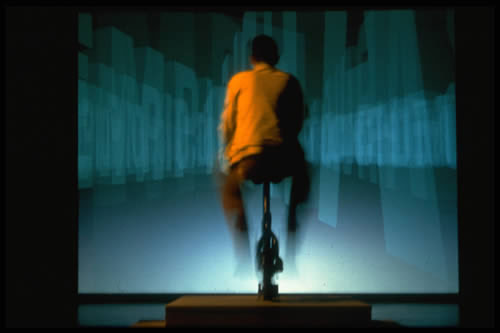
I also found very interesting the work of Jeffrey Shaw and more specifically the Legible City project . “In The Legible City the visitor is able to ride a stationary bicycle through a simulated representation of a city that is constituted by computer-generated three-dimensional letters that form words and sentences along the sides of the streets. Using the ground plans of actual cities - Manhattan, Amsterdam and Karlsruhe - the existing architecture of these cities which is based on actual maps, entirely consist of texts, which are projected on a large screen in fort of the user. Traveling through these cities of words is consequently a journey of reading; choosing the path one takes is a choice of texts as well as their spontaneous juxtapositions and conjunctions of meaning.”

This project also reminded me find that the idea of “representation” is a subject that I am very interesting in and how it has been always my concern during all my work with signage. What I like about Shaw’s project is the idea of navigating the city through its representation giving the user a different approach and a different reading of it. The city is a map of the city made by words.

It this case, the representation of the city with text is equivalent as the act of “translating the characteristics of the hypertext into architecture, and representing a city using a different codification”.

I also like the idea on how this projects deals with the idea of customization. In this case, the reader-walker constructs his own narrative while choosing a path in the virtual city.

I also found other interesting projects on Digital Art book that create virtual environments and sensations on a space that doest exist; virtual architectures that change and respond to the user inputs. ( Erwin Redl, Polar Project, among others) .

Wednesday, July 12, 2006

Zaha Hadid and architecture

I went ton see the Zaha Hadid exhibit at the Guggenheim with my friend Eniko who studies architecture at Pratt. The exhibition was good and I reinforced my interest and passion for architecture. Most of her projects were just experimental and were not built. There were a lot great mock-ups where all the spaces seem to be so designed that there was no room for placing anything else. When looking at the mock ups I just had a thought about how could be a signage for a building like those. I had the idea that it would have to be almost invisible. On the contrary that I have always thought –than signage has to be hug and very visible- in this case I changed my mind. Not in the sense that it would have to be small and discreet but in the sense that just should be visible when someone needs it. Could be in the walls, in the floor or in the ceiling but would only show up when someone requires the info. I also remembered the signage project for in Mexico’s Electric Central and it was made with projections on the walls. I am going to find more information about it.

Portability and others

The other day I was walking with my friend Alejandro doing my “thesis homework” that consist of visiting as much of art and design as possible. I found a very funny intervention in a public space called Portable Architecture by Kim Holleman, It consists of a living park environment housed within an 18’ x 8’ x 7’ travel trailer and was part of the exhibition “Portable”.

It reminds me in some way Datacity Project because of the idea of portability. Datacity is a prototype of an interactive display system that provides contextual information to users as it travels with them through the New York City skyline. (Made by students at ITP). It is an attempt to give the users access to the information regarding the city in real time. What I found interesting about this is the idea of the City as a Museum and how a mobile vehicle acts as the interface that explains the exhibition. I also found interesting the idea of having the information available but just being displayed in the moment that the visitor asks for it.

I also went to the new museum and I saw a very interesting exhibit called Still Men Out there by the video Artist Björn Melhus : “In a darkened space, three circles, each consisting of five monitors, are arranged, with a sixth in the center. Melhus declines to use any ‘pictures’ in this one. Instead, an impressive sound collage comprised of original quotes by members of the government and actors from Hollywood movies are backed by the pseudo-heroic music of the crusades and ‘illustrated’ with the various monochrome colors of the monitors.“

What I found interesting about it was the idea of creating sensations without any images. Just using light and sound, a “cinematographic environment” was created and it was strong enough for the audience to have a “mental image” of what was happening behind the screen.

Julian Opie's Work


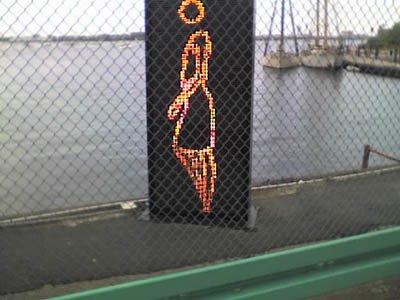
Here in NY at the City Hall and in Boston at the river I run into Julian Opie’s work. Suzanne and Julian walking. At the beginning I found them interesting because they were like “icons” walking and I am very attached to those kinds of representations. Then I realized the animation was really accurate, and simulates a real person walking. I found Opie’s work interesting as an intervention in a public space and my interpretation was that he was trying to focus on the importance of walking become this act an “icon” that characterize pedestrian cities as New York, Boston or Tokio. “… the figures appear to walk endlessly 24 hours a day with mesmerizing ease, evoking the strength of Boston as a pedestrian-friendly city.”

He is inspired by mass-media and by the technological and commercial visual bombardment of our world to create representations of different object in the city: people, trees, roads, cars, and buildings. Most of his work is always placed in public spaces such as museums and galleries to billboards, hospitals, airports etc.

When I work in signage projects my first step is always to find out what are the characteristic of the place that make it to be unique. This is my starting point. I just have the thought that was interesting how Julian creates an installation that was representing an specific characteristic of a place, in the case, the city itself.

Saturday, July 01, 2006

SAUMA

Last week I went to SAUMA at the Courtyard gallery. It is an exhibition about contemporary design from Finland. I found four interesting pieces.

Graphic concrete
This method in which graphics can be printed on the concrete, gives the possibility to have the graphics embedded on the walls. I like the idea of the design being part of the building and not something that is added as an external element.

I also liked Title Toy, a modular electronic game for tangible LED game titles.

City Wipeout was an interface that allows users to wipe in a city picture everything but the advertisement. Although the results were not that smart the concept and the modes of interaction have a lot of potential.

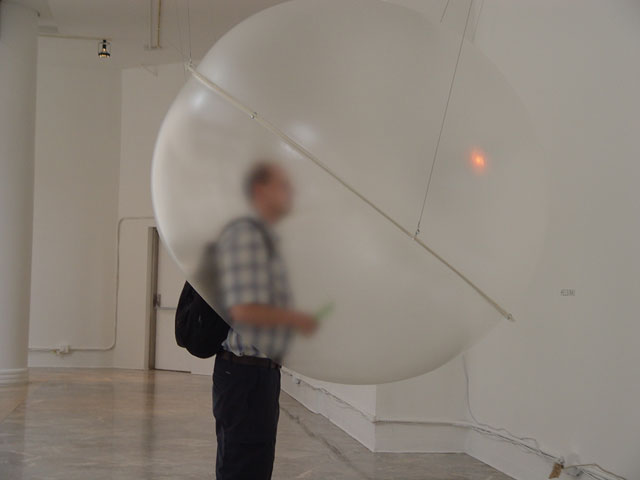
Air Urban olfatoty installation is a set of three bubbles that contain the smell and some videos that reveal personal experiences of three cities. Again, good ideas with not that good final results.

Rafael Lozano-Hemmer Work

Last Spring I went to a lecture at the Guggenheim to see Rafael Lozano-Hemmer work. As I have told his thoughts and his work were amazing. I was reading an article about "calming technologies" and in the back of the article I wrote some comments about the lecture. He explained some of his projects and I really liked how simple and how complex they were at the same time.


I had some thoughts about them.

How images (projections) can transform architecture?

How the identification of a building could be the building itself?

How a label can become the object that it is identifying? (Calvino, City and Signs). I have forgotten how important was this book while I was doing my college thesis and how pleasant was to reinforce that while doing the box project.

“SUBTITLED PUBLIC consists of an empty exhibition space where visitors are tracked with a computerized infrared surveillance system. As people enter the installation, texts are projected onto their bodies: these “subtitles” consist of thousands of verbs conjugated in third person and they follow each individual everywhere they go. The only way to get rid of a subtitle is to touch someone else: the words then are exchanged between them.”

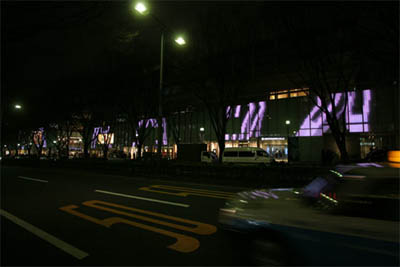
“1000 PLATITUDES Words commonly used to describe the generic globalized city are written with a created alphabet; --each letter of the alphabet was projected on a different building using the World's most powerful projector. Public housing projects, shopping malls, government buildings, industrial wastelands and corporate headquarters were transformed by fast tactical projections from the mobile platform, under the radar of potential regulators.”

“BODY MOVIES transforms public space of interactive projections. Thousands of photo portraits taken on the streets of the cities where the project is exhibited are shown using robotically controlled projectors. However, the portraits only appear inside the projected shadows of local passers-by” He talked about massive interactivity."

UNDER SCAN reminded me of major studio mid terms reviews when the critics said that when you create interactive installations you have to be very careful about the modes of interaction. They pointed out that these modes should be conceived in a way that participants cann't help to interact. And Lozano-Hemmer does it in a brilliant way. Here is the simplicity which I find amazing; people just have to walk and what could be more natural than walking?

VECTORIAL ELEVATION
The idea of having messages that are transformed into information that become light, three-dimensional light.

I also was thinking that I want to explore more the work of Christo and his landscape transformations.

He offered an amazing workshop called HUMO that consists of rapid deployment of strategic images to transform urban landscapes.