What I consider most valuable about my experience at Siggraph was having the opportunity of swimming in the technology arena and learns about what was going on as much as I can. I could have a general idea about what is possible and what is not and when technology is really a medium and when is a purpose. My general overview regarding the art gallery was that almost every project was based on the idea of magic trick. Although there were a lot of interesting projects I found out that I saw more technological experiments that design or art projects.
Some of the projects that I liked:
1 Bubble cosmos:Beautiful piece that consists of a bubble display system that projects an image onto a real bubble containing smoke and changes the sound effect and image when bubble burst.
Again, it was very charming: Is like a piece of magic, pure illusion.
2 TablescapeThis was one of the projects that I like most. It is a tabletop display where you can interact with physical objects. Although I had the feeling the some of its applications were not that interesting, the potential of the technology is very height. I found the modes of interaction very compelling (the interaction with physical objects) and I also liked the idea of changing an object on a scenario, (his characteristics or appearance) depending on the user input. I loved the animation where the interaction with the little blocks produces a conversation between animated characters. Other similar project that works with the same principle but applied to architecture was
Deskrama.
3 Tangibility and Phisicality
Talking about Physical objects that activated virtual environments, this was an idea that was everywhere at the exhibition. I assume that this is part of the tendency which aims to minimize the feeling of interacting with the virtual word. It is related to the idea of letting the user to manipulate the virtual through the real making him feel the experience “more true, more tangible”.
And talking about tangibility another great project was
MRI, a tangible experience. Where physical objects are linked whit digital content: “Human Senses come first and computer technology stays in the background”.
I also liked the Shared space design and the Multi-Touch Interaction. The goal of these two projects is also related to the idea of “feeling and manipulated the virtual with your own hands”. Although I think there is still along way to go to achieve this goal, again the potential of the technology is very height. People using the screens seems to be very involved and while playing with it and I really had the feeling that I was manipulating virtual data with my hands.
And other project that I also found very interesting was
Light Attack.
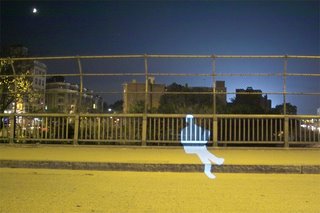
Light Attack is a media artwork, as well as social experiment, performed in public urban spaces. While driving through the city, an animated virtual character is projected onto the cityscape, exploring places ‘to go’ and places ‘not to go’, according to the popular Lonely Planet travel guide. I like the idea of creating a character, an ordinary tourist guide who travels around the city and specially the idea of public and private. It reminded me the work of Julian Opie. I also find interesting the question that rises from the project: property and privacy: how public is public space? How is ‘projection’, as a ubiquitous medium, changing the environment in which we live?
4. Lisa Erdman:
Drugs to change you.Very clever, good concept, very accurate graphics and also very simple. This project made me think of how much I like the way that I did last semester when adding some “sense of humor” to my projects and I also realized that Music is a very interesting component. Lisa talked about irony & satire as a way of express our ideas and state our concerns and ideas to society.
5 Herminia Wei Hsin DinExploring Educational games in Museums
Interesting talk about Exploring Museums through games.
Herminia pointed out that a Museum is a place that exhibit, collects, educates, preserves and “talks”.
Regarding Types of Museum Online Educational Games she mentioned
Role-play
Simulation
Creative Play
Puzzle and Mystery
Interactive Reference
Building Learning Resources
Visit :
Museums and the WebThe American Association of Museums 6 Also nice talked about teaching 3D modeling software through art using Hopper’s Nighthawks .
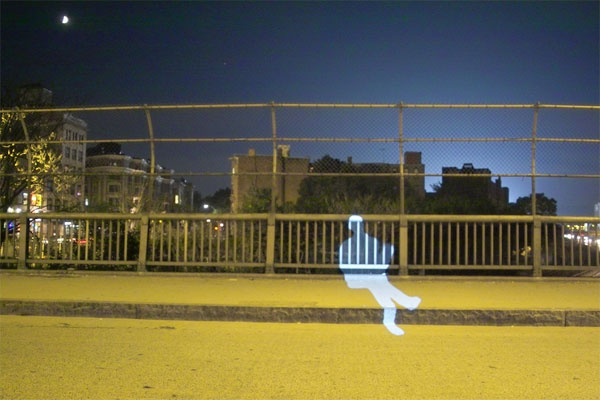 Light Attack is a media artwork, as well as social experiment, performed in public urban spaces. While driving through the city, an animated virtual character is projected onto the cityscape, exploring places ‘to go’ and places ‘not to go’, according to the popular Lonely Planet travel guide. I like the idea of creating a character, an ordinary tourist guide who travels around the city and specially the idea of public and private. It reminded me the work of Julian Opie. I also find interesting the question that rises from the project: property and privacy: how public is public space? How is ‘projection’, as a ubiquitous medium, changing the environment in which we live?
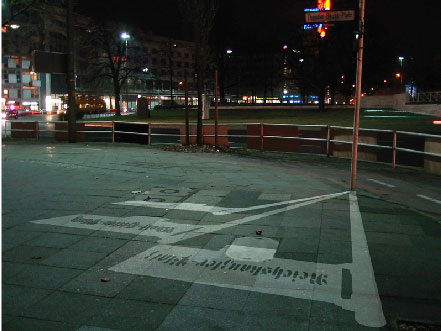 Recently I have been thinking about the idea of the tons of information that we receive everyday. It is impossible to grasp everything and it is very hard to process. Most of it is unnecessary and some of it, which it is very relevant, it is not shown. What is the information that we really need to know and when is the right moment to display it ?
