More References
I presented my project last week and it seems that I am in the right track. I am going to desing an a project that allows people to explore the private life of the city. ( Using peepholes / wall cracks as interfacaces and video as content). My concern now is HOW to formalize the project but more than that is WHAT is going to be the content of the videos. I need to start experimenting and recording some videos in order to figure out what stories do I want to tell.
I started doing some small experiments videotaping friends and trying to see what is more interesting. I found out that video without sound is much more complelling that having both because it generates a lot of curiosity. Having a still image and sound it is also another choice.
I have been looking at different projects / artist / and experiments that deals with the idea of “spying and looking at people's private daily events”.
Shaun told me about feeds for networked security cameras. I was looking at a parking lot and it was really nice when I could see some cars moving. It made me think how exiting it would be if I can so something in real time, but I guess this would be another story.
Chris Sugrue who graduated from Parsons did a set of experiments for her thesis related to vision tracking. Re-Gaze explores relationships between vision and imagery. It emerges from an investigation into the human visual system, eye tracking, visual illusion, and studies in psychology and cognitive science. Within the installation, the visual fixations and eye movements of an individual cause a sequence of images to react, form and respond to being seen. This interactive process of viewing engages the audience with a dialog about the public and private, voluntary and involuntary manifestations of looking and seeing. Vision tracking: Used computer vision techniques to develop create C++ system to track human eye movements.
Bill Viola and his Sleepers, a video installation in which seven black-and-white monitors showing unedited recordings of various sleeping faces are positioned in metal barrels filled to the brim wit water, the soft light from the video screens diffusing in the room, the viewer is confronted with an almost Kafkaesque nightmare of unconscious alienation. Interesting quote about images vs sound that is one of my concerns while doing videotaping people: “ the spectator has to pass through the silent, but optically very ‹loud› electronic flow of data, in order to reach a dark space”.
Dieter Roth: «Solo Scenes».
A video-installation (here in the gallery Hauser & Wirths, Zurich) with 128 videotapes presented alternately on at least 40 monitors. The tapes demonstrate Dieter Roth´s everyday life and were recorded from 3rd March 1997 to 28th April 1998 in Bali, Iceland and various places in Basel. The following animated stills render the idea of the work.
Tenement Museum
Interesting and lovely on lines tours to see emigrants’ houses.
I will go to check how are the real tours (The Confino Family Apartment: This "living history" apartment is based on the Sephardic-Jewish Confino family from Kastoria.
Ellen Harvey
The paintings were the work of well-known artist Ellen Harvey. Documented here are both the works and Harvey's diary-like experiences of painting illegally throughout the city. The narrative of her “beautification project” is both provocative and hilarious. It touches on serious issues, such as who is allowed to make art in our society and what distinguishes art from graffiti, while never losing touch with the frequently comical reality of creating a contemporary art project on the streets of New York.
Peepholes
Project made at ITP that use a peephole as an interface to allow a person to look through a keyhole in a door in one space and view inside an old living room in another space. In the old living room, there is an old console television; the eye of the person that is peeping into the room is displayed on the old TV. They were inspired by the constraints of privacy in our world today and by the idea of how we see the world and how the world sees us.
Jonas Dahlberg
Finding one's bearings - on Jonas Dahlberg's intermediary spaces
Discovered that from his windows he had an unimpeded view into his neighbour's house on the other side of the street. The wall in there was decorated with an arsenal of weaponry. This threatening image in his existence prompted the artist to furnish his own apartment only as far as the zones that the other man in turn could not see. See other works.
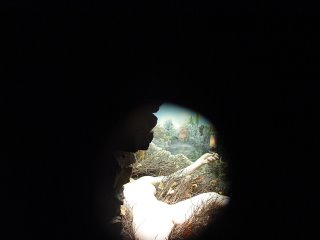
Marcel Duchamp
Given:1. The Waterfall, 2. The Illuminating Gas.
I started doing some small experiments videotaping friends and trying to see what is more interesting. I found out that video without sound is much more complelling that having both because it generates a lot of curiosity. Having a still image and sound it is also another choice.
I have been looking at different projects / artist / and experiments that deals with the idea of “spying and looking at people's private daily events”.
Shaun told me about feeds for networked security cameras. I was looking at a parking lot and it was really nice when I could see some cars moving. It made me think how exiting it would be if I can so something in real time, but I guess this would be another story.
Chris Sugrue who graduated from Parsons did a set of experiments for her thesis related to vision tracking. Re-Gaze explores relationships between vision and imagery. It emerges from an investigation into the human visual system, eye tracking, visual illusion, and studies in psychology and cognitive science. Within the installation, the visual fixations and eye movements of an individual cause a sequence of images to react, form and respond to being seen. This interactive process of viewing engages the audience with a dialog about the public and private, voluntary and involuntary manifestations of looking and seeing. Vision tracking: Used computer vision techniques to develop create C++ system to track human eye movements.
Bill Viola and his Sleepers, a video installation in which seven black-and-white monitors showing unedited recordings of various sleeping faces are positioned in metal barrels filled to the brim wit water, the soft light from the video screens diffusing in the room, the viewer is confronted with an almost Kafkaesque nightmare of unconscious alienation. Interesting quote about images vs sound that is one of my concerns while doing videotaping people: “ the spectator has to pass through the silent, but optically very ‹loud› electronic flow of data, in order to reach a dark space”.
Dieter Roth: «Solo Scenes».
A video-installation (here in the gallery Hauser & Wirths, Zurich) with 128 videotapes presented alternately on at least 40 monitors. The tapes demonstrate Dieter Roth´s everyday life and were recorded from 3rd March 1997 to 28th April 1998 in Bali, Iceland and various places in Basel. The following animated stills render the idea of the work.
Tenement Museum
Interesting and lovely on lines tours to see emigrants’ houses.
I will go to check how are the real tours (The Confino Family Apartment: This "living history" apartment is based on the Sephardic-Jewish Confino family from Kastoria.
Ellen Harvey
The paintings were the work of well-known artist Ellen Harvey. Documented here are both the works and Harvey's diary-like experiences of painting illegally throughout the city. The narrative of her “beautification project” is both provocative and hilarious. It touches on serious issues, such as who is allowed to make art in our society and what distinguishes art from graffiti, while never losing touch with the frequently comical reality of creating a contemporary art project on the streets of New York.
Peepholes
Project made at ITP that use a peephole as an interface to allow a person to look through a keyhole in a door in one space and view inside an old living room in another space. In the old living room, there is an old console television; the eye of the person that is peeping into the room is displayed on the old TV. They were inspired by the constraints of privacy in our world today and by the idea of how we see the world and how the world sees us.
Jonas Dahlberg
Finding one's bearings - on Jonas Dahlberg's intermediary spaces
Discovered that from his windows he had an unimpeded view into his neighbour's house on the other side of the street. The wall in there was decorated with an arsenal of weaponry. This threatening image in his existence prompted the artist to furnish his own apartment only as far as the zones that the other man in turn could not see. See other works.
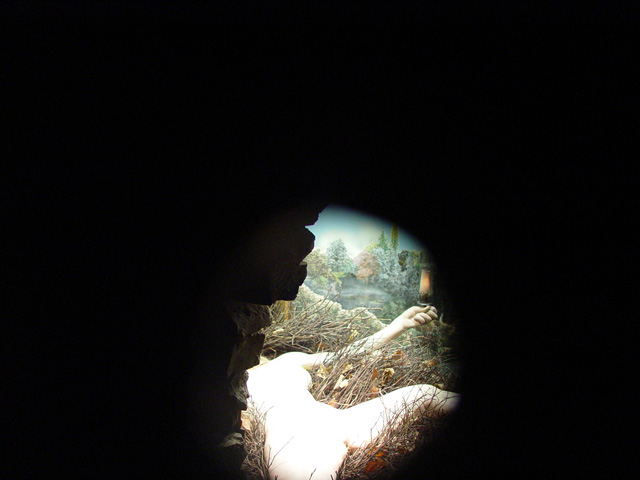
Marcel Duchamp
Given:1. The Waterfall, 2. The Illuminating Gas.

0 Comments:
Post a Comment
<< Home